
Satoshi Ikehata, Shota Imafuku, Teruo Matsubara, and Nozomi Kobayashi
from the Business Co-Creating Consulting Department
The advancement of AI technology including generative AI is rapidly driving companies to utilize AI. AI is receiving growing attention not only for the purpose of operational efficiency but also as an element which affects corporate value; however, the number of companies which have successfully materialized its positive impact on their business operations is still limited. NRI is surveying and analyzing viewpoints, treating AI utilization as a challenge at the managerial level, to enhance company-wide value. In this installment, we ask Satoshi Ikehata, Teruo Matsubara, Shota Imafuku, and Nozomi Kobayashi, who are in charge of assisting companies with AI transformation, about the meaning and key points of being committed to AI utilization.
An era in which AI utilization affects corporate value

Matsubara points out that the purpose of AI utilization has been recently diversifying away from better efficiency of individual tasks on each site toward the creation of new experiences and new value for customers. “This trend shows that we have reached the stage where corporate business models and operations are being replaced by AI-native ones.”
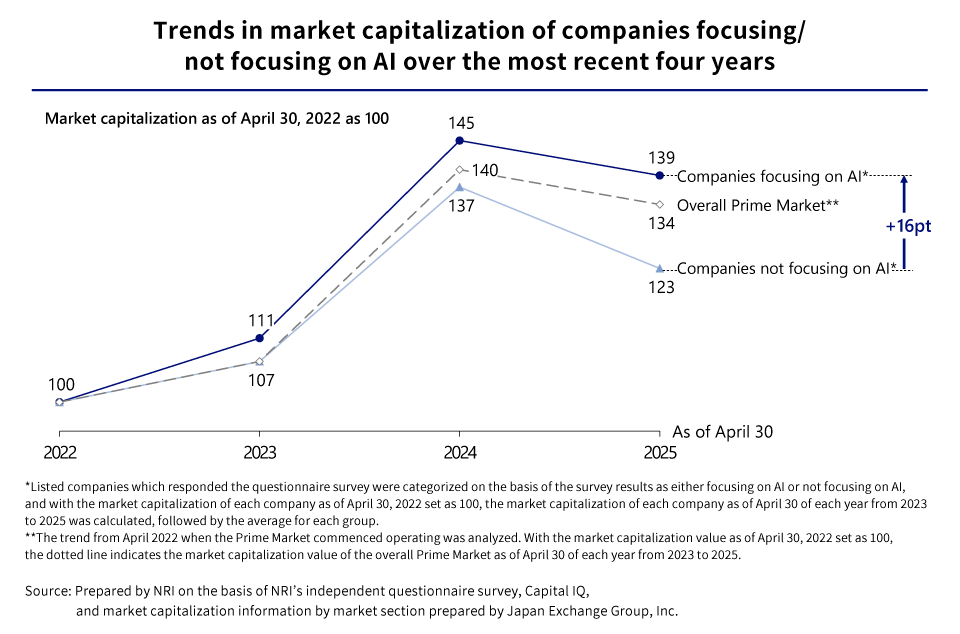
“Companies focusing on AI”, as defined by NRI, are promoting AI utilization in organic cooperation between management and work sites, and as such, are characterized in that the business decision-making functions and AI deployment at work sites are moving forward in an integrated fashion. Our survey found that the market capitalization growth rate of such companies exceeds the average of the entire market. Matsubara continues by saying, “Investors have large expectations for AI utilization. Some companies are explaining at their IR information sessions etc. that cost reductions and quality improvements through AI utilization have contributed to improved performance.” The era has arrived in which AI utilization is actually creating a positive business impact, gaining attention from the market, and boosting corporate value.
The “business impact barrier” faced by many companies

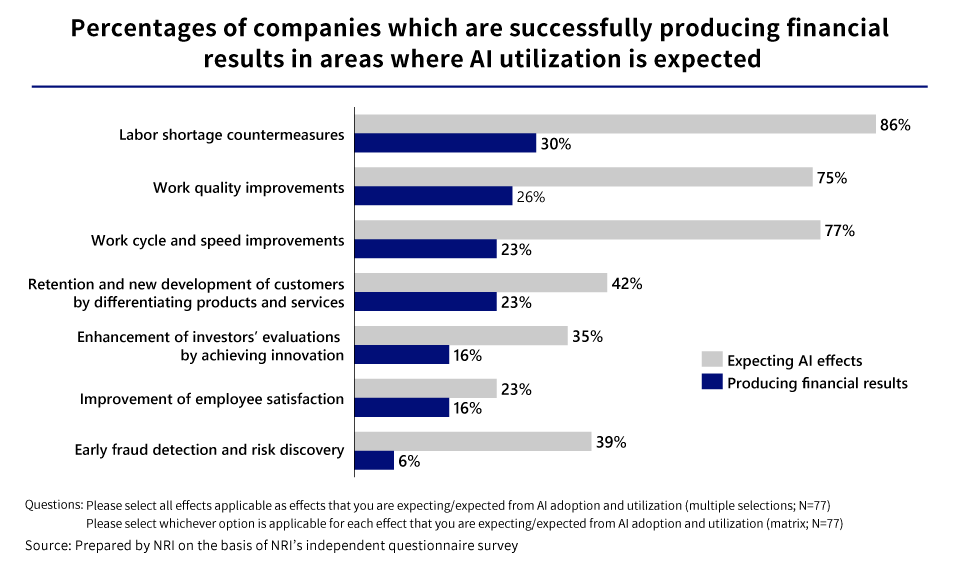
Companies are making steady efforts to utilize AI, but there are many cases where the effect of AI is limited to better efficiency at work sites, and falls short of producing financial results. Imafuku explains that behind such cases, there are challenges including the lack of data infrastructure for AI utilization, weak collaboration between the management and work sites, and the lack of a return-on-investment viewpoint.
In order to produce financial results, it is essential to adopt the approach of identifying AI’s impact on the entire business and concentrating investment in areas where it will have a large impact. For example, in case of the financial industry, if generative AI can improve the quality of work in which a large number of people are engaged, such as sales and marketing, the performance of the entire organization will be significantly improved. Rather than changing the work done by 10 employees, improving the quality of 10,000 employees will directly affect the profit structure of the entire company.
Matsubara says, “The problem is that the introduction of AI is not discussed in the ‘context of corporate transformation’, and in order not to “end with its adoption,’ it is important to identify the areas in which AI will be deployed in consideration of financial returns, and run an improvement cycle on a continuous basis.”
Spreading successful experiences in one area across the company

In order to produce financial results, it is important to first promote AI utilization in an area where it can be expected to have a large impact, and then, spread successful results produced in that area to other areas. Kobayashi says, “It is easier for departments in which there are many similar job types and operations to see an impact, in terms of investment efficiency as well.” A typical example would be work sharing common processes such as sales and marketing, administrative work, and call centers.
Meanwhile, it is critical to put in place a “cross-organizational function” to broadly deploy successful results across a company. Namely, if a process which has been successful in one department is standardized and other departments share and introduce the same process, then that process can quickly permeate across the company.
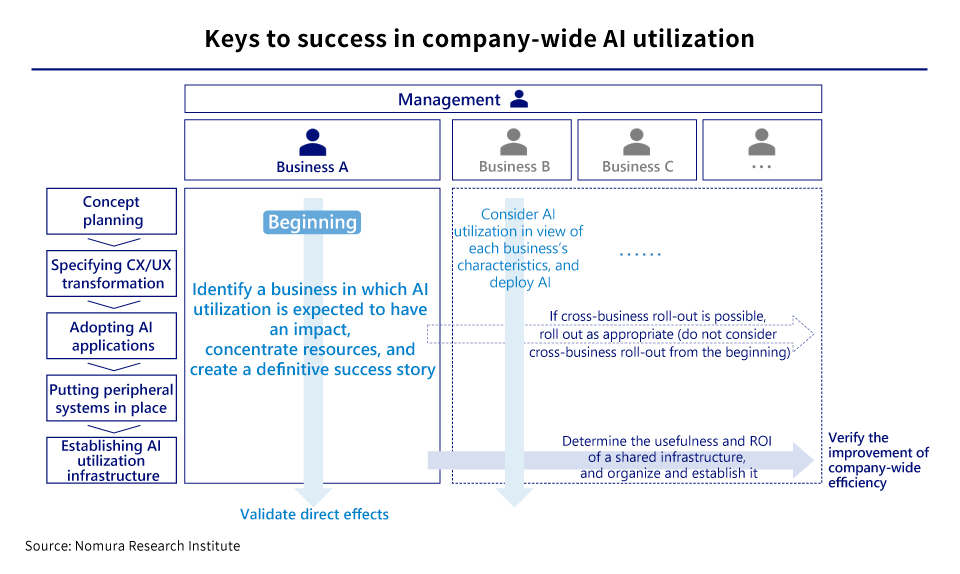
A survey conducted by NRI observes the trend in which firstly, one department experiences good results, and then, on the basis of such experience and knowledge, common rules, a data infrastructure for AI utilization, and cross-organizational functions are put in place, thereby smoothly rolling AI out across the company. If a shared infrastructure is established, a company-wide roll-out will be easier also from a ROI perspective because each department can reduce the cost of AI introduction.
Additionally, given the evolving speed of AI technology, it is also important not to be bound by a particular generative AI model, but instead to design a flexible infrastructure that envisions switching to the latest model. Having an architecture which can adapt to such changes is the key to continually proceeding with AI utilization.
Four comprehensive approaches to achieving AI transformation
In AI utilization going forward, the quality and structure of the data which the AI learns will have a great impact on corporate value. Ikehata says, “It is critical for data such as the know-how that has been accumulated here and there in a company to be inputted into the AI in an appropriate format.” If data are decentralized for each department, AI cannot display its full competence; therefore, it is essential to have a mechanism to organize and share data as an asset across the entire company. Companies focusing on AI have already reached this stage, organizing a cross-departmental data utilization infrastructure and building an environment where AI can understand knowledge across the entire company. More sophisticated determinations and proposals become possible by enabling the AI to refer to knowledge unique to a company so that it can understand the context necessary to solve a problem.
In order to assist such efforts, NRI links four viewpoints to each other: management and business, work and operations, AI technology, and IT systems supporting the foregoing, and provides comprehensive support from strategy-making to achieving transformation. Teams of experts in consulting, IT solutions, and AI technology with a deep understanding of customers’ industries and operations are closely working together and manifest integrated strength.
Lastly, Ikehata says, “The adoption of AI should not end with ‘slightly better work efficiency, and it is important to position it as a strategy to enhance corporate value. The future shape of a company depends on how it utilizes AI. We want to accompany our customers and support them in their steady transformation.”
Profile
-
Satoshi IkehataPortraits of Satoshi Ikehata
Head of Business Co-Creating Consulting Department
Since joining NRI in 2008, Satoshi Ikehata has focused on consulting for the automotive, electronics, materials industries, and general trading companies. His focus has been on medium-term management planning, business strategy development, M&A, alliances, and structural reform projects. More recently, he has worked on optimizing corporate activities using data and developing new businesses through digital technology. As President of the Business Co-Creation Consulting Department, he has embraced the mission of "co-creating visible impact." He provides consulting services that emphasize achieving results, particularly in the digital domain, with a strong emphasis on strategic and conceptual planning.
-
Shota ImafukuPortraits of Shota Imafuku
Business Co-Creating Consulting Department
-
Teruo MatsubaraPortraits of Teruo Matsubara
Business Co-Creating Consulting Department
-
Nozomi KobayashiPortraits of Nozomi Kobayashi
Business Co-Creating Consulting Department
* Organization names and job titles may differ from the current version.